The holiday visit is over. You hugged Mom at the door, got back on the highway or the plane, and now the old question rides home with you: how is she really doing when I'm not there? If you help an aging parent from another city or state, you are a long-distance caregiver – and you are far from alone. This guide shows how to stay close from far away, build a small team near your parent, and make senior safety at home part of a plan your parent agrees with.
What is long-distance caregiving?
Long-distance caregiving means helping an older parent or relative you don't live near. You may not do the daily tasks, but you can still organize, plan, check in and support the people who are nearby.
It is a common situation. An AARP and National Alliance for Caregiving report counts 51 million family caregivers who care for an older adult. Most live with, or within 20 minutes of, the person they help (74%) – which means millions of others are managing from farther away, often with work and children of their own. The National Institute on Aging (NIA) notes that when you live far away or see someone rarely, it can be hard to notice when they need help.
Start with what your parent wants
The best long-distance plan is built around your parent's wishes, not around your worry. Ask what matters most to them – staying in their own home, keeping their routines, driving to church, gardening – and plan the support around that.
This is where many families get stuck: a parent's wish to stay independent and a child's wish to know they're safe can feel like they pull in different directions, and care options can be hard to bring up. A few phrases help:
- "What would make your days at home easier?"
- "What would help me worry less when I'm back home?"
- "Can we try one thing for a month and see how it feels?"
Asking first turns the talk into teamwork. It also keeps the decision where it belongs – with your parent.
Build a small team close to home
You can't drop by, so find two or three people who can. NIA suggests that, with your parent's permission, you ask neighbors, friends, doctors or local relatives to call you if they have concerns.
Your local team might include:
- A neighbor who notices if the newspaper or mail piles up.
- A friend or relative nearby who has a spare key and can stop by.
- A faith community, club or friendly-visitor program – NIA describes volunteer programs that make short social visits, often at no cost.
Write everyone's name and number on one shared list, and make sure your parent knows who is on it and why.
Organize the important information now
When something comes up, the hardest part from far away is finding the right information fast. NIA's tips for long-distance caregivers start here: keep vital paperwork in one place and up to date, share copies with other caregivers, and make sure at least one caregiver has written permission to receive medical and financial information.
A simple checklist to finish before or right after the holiday visit:
- Doctors' names and phone numbers, and the pharmacy.
- A current list of medications (your parent can keep a copy on the fridge).
- Insurance cards and key account information, stored safely.
- Written permission (with your parent's agreement) for one family member to talk with doctors.
- Who has a spare key, and how to reach them.
Stay connected without hovering
Regular, light contact works better than worried calls. NIA recommends staying connected and updating trusted family members, and a shared family calendar or group chat keeps everyone on the same page.
Ideas that feel caring, not controlling:
- A set time for a daily or every-other-day call, so a missed call doesn't cause panic by itself.
- A family group chat for quick photos and updates.
- Joining a doctor's telehealth visit by phone, when your parent wants you there.
- Planning your next visit around something fun, not only chores – NIA suggests asking in advance what your parent would like to do.
How a 24/7 help button fits into a long-distance plan
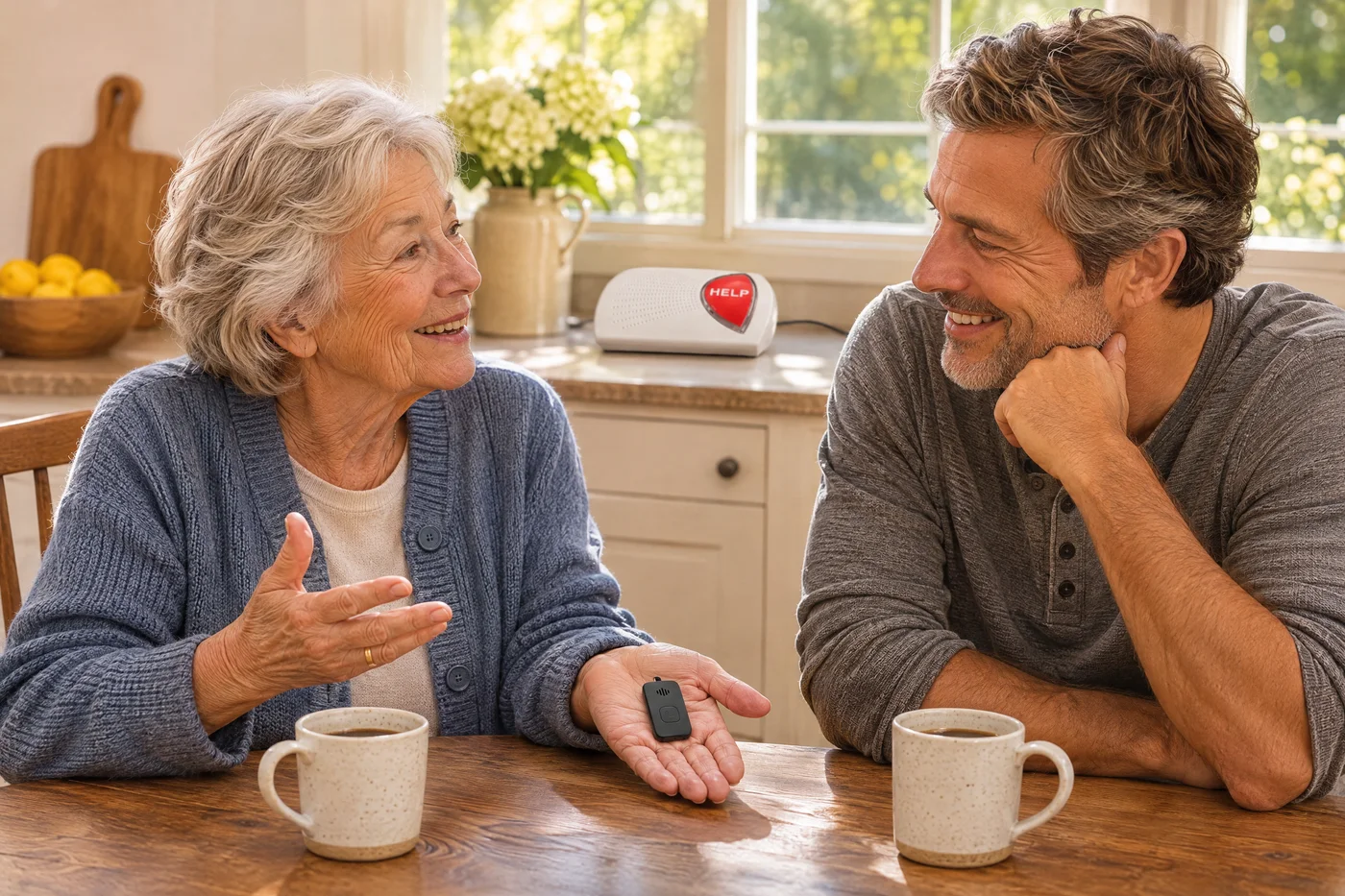
A medical alert system gives your parent a way to reach help with one press, any time, even when family is hours away. It doesn't replace your calls or your local team, but it adds a reliable link for the moments in between.
Here is how it works with 24 Rescue Alert:
- One press, a real person answers. Your parent presses the help button and a U.S.-based operator answers, 24/7, and talks with your parent through the device.
- The right people get called. The operator talks with your parent and contacts family or 911 as needed – so the people on your shared list stay in the loop.
- At home and on the go. The In-Home system covers the house; the On-the-Go device with GPS goes along to the store, the park or the doctor. No landline needed.
- Fall detection available, for families who want an extra layer.
- A Caregiver App for family is part of the system.
- Spanish support, a 30-day risk-free trial and free standard shipping.
NIA notes that emergency alert systems won't help in every kind of emergency and can't replace regular check-ins from family and friends. That is the right way to see it: one part of a plan that also includes people who care.
Why many families think about this now: the CDC reports that more than one out of four older adults falls each year. A help button worn every day means that, if a fall or any other problem happens while you're far away, your parent can still reach someone.
Bringing it up after the visit
You don't have to settle everything at the Thanksgiving table. In The Senior List's 2026 survey, only 26% of adult children said they had discussed medical alert devices with their parents – so if you haven't yet, you're in good company.
A gentle way to start: share something to read together. Our free printed guide is made for exactly that – it arrives in the mail, it's easy to read, and it gives your parent time to think it over on their own terms. If you'd rather talk it through, a specialist can answer questions on a free call, in English or Spanish.
Frequently asked questions
How far away do you have to live to be a long-distance caregiver?
There is no exact distance. If you can't easily stop by to help in person, and you support your parent mostly by phone, online and occasional visits, you are caring from a distance.
How can I check on my elderly parent from another state?
Set a regular call time, keep a shared contact list, and ask a nearby neighbor or relative (with your parent's permission) to call you if something seems off. A medical alert system adds a way for your parent to reach a 24/7 operator with one press.
Who gets called when my parent presses the help button?
A U.S.-based operator answers first and talks with your parent through the device. The operator then contacts family or 911 as needed.
Does my parent need a landline for a medical alert system?
No. 24 Rescue Alert systems work without a landline, at home and on the go.
Your next step
Caring from far away is easier with a plan your parent helped make. Start with one conversation, one shared list and one simple tool.
Get the free printed guide – mailed free; it usually arrives within 5–7 business days by U.S. mail.
Talk to a specialist for free
No obligation, Spanish support available. 30-day risk-free trial · free standard shipping.
Related reading: Living Alone After 65: 9 Ways to Stay Safe and Independent · Home Safety Checklist for Older Adults
Sources
- CDC – Older Adult Falls: Facts and Stats
- National Institute on Aging – What Is Long-Distance Caregiving?
- National Institute on Aging – Long-Distance Caregiving: How Can I Help if I'm Far Away?
- National Institute on Aging – Does an Older Adult in Your Life Need Help?
- National Institute on Aging – Services for Older Adults Living at Home
- AARP and National Alliance for Caregiving – Caregiving in the US 2025
- The Senior List – 2026 Medical Alert Device Usage Report
Statistics: Source: CDC; National Institute on Aging; AARP and National Alliance for Caregiving; The Senior List. These organizations do not endorse 24 Rescue Alert. This article is general information, not medical advice. In an emergency, call 911.